The Family's Two Marks
The Coat of Arms & the Family Emblem
Two symbols, nearly five centuries apart, that together tell one family's journey — from a goldsmith's guild in Zürich to a hillside in York County, Pennsylvania.
The Medieval Coat of Arms
The Glattfelder Coat of Arms

First recorded 1606 · Zürich, Switzerland
High-resolution PNG · free for family use (see below)
The family's oldest mark reaches back to medieval Zürich. The Glattfelder coat of arms was first recorded in the Zürich Coat of Arms Book of 1606 — though the family name itself appears in official documents as early as 1315. It told the story of a master goldsmith's guild in Zürich, marking the family's place and trade in the city centuries before anyone crossed the Atlantic.
The name comes from the village of Glattfelden — literally "the field on the river Glatt" — in Canton Zürich, where the family's records in the village church run back to Adam Glattfelder in 1570. Casper, the immigrant who carried the name to America in 1743, comes five generations later.
This is the older of the family's two marks. When the Association designed its own emblem two centuries afterward, the stars ringing that newer design were drawn deliberately to echo this medieval coat of arms.
The Association Emblem
The CGAA Family Emblem
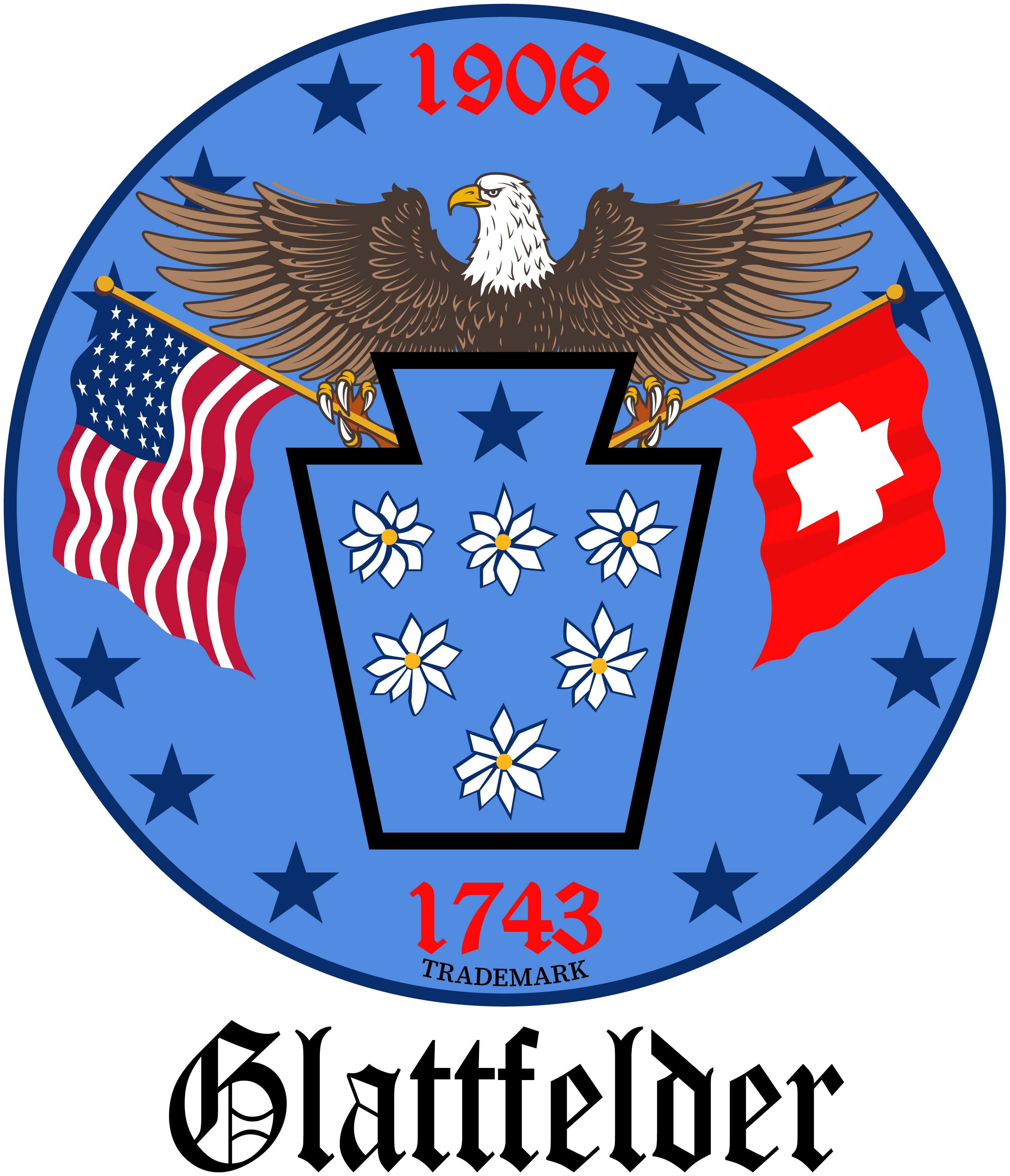
Adopted 1911 · Revised 1987
In 1911, the Association adopted a family emblem, designed by Samuel Glatfelter (1858–1927 and 5th generation direct descendant through Casper's son Casper). Revised in 1987, it remains the visual symbol of the Glattfelder family in America — and every element tells the family's story in miniature.
At the center sits a Pennsylvania Keystone, the unmistakable symbol of the commonwealth where Casper settled after emigrating from Switzerland in 1743. Within the keystone are six edelweiss flowers, one for each of Casper's sons. The edelweiss — the iconic alpine flower of Switzerland — placed inside the keystone forms a quiet metaphor: Swiss heritage carried forward within an American identity.
Above the keystone stands an American eagle with wings spread, clutching the staffs of two flags — the American flag and the Swiss flag — reflecting a family that has never seen its Swiss origins and its American life as being in tension. Two dates frame the composition: 1743, the year Casper arrived in Pennsylvania, and 1906, the year his descendants organized the Association. Stars encircle the border, echoing the original medieval coat of arms and symbolizing that the descendants of Casper Glattfelder have spread across the continent.
Where the medieval coat of arms told the story of a goldsmith's guild in Zürich, the Association emblem tells the next chapter: emigration, settlement, and the deliberate choice to remember where the family came from.
Permissible Use
Who may use each mark
The two marks carry different permissions. The Casper Glattfelder Association of America exists to keep Casper's descendants connected to one another and to their shared heritage — preserving the family's record and bringing the family together. The coat of arms belongs to that purpose and is yours to use. The Association emblem is the Association's own trademark.
The Coat of Arms
Any member of the family is welcome to use the Glattfelder coat of arms to celebrate and promote the family — on personal projects, family gatherings, keepsakes, genealogy work, and anything that helps keep Casper's descendants connected to their shared heritage.
Please use the official file provided here and don't alter the artwork, so the mark stays consistent wherever the family appears.
The Association Emblem
The CGAA emblem is a trademark of the Casper Glattfelder Association of America. It identifies the Association itself and should be used only by the CGAA, for official Association business.
If you'd like the Association's emblem used in connection with a family project, please reach out to the Association first.
Explore the Association
Four ways to be part of the family.
Weekly Stories
The Glattfelder Gazette
A free weekly email telling the stories of the family — one short, readable piece a week, drawn from nearly three centuries of records.
Read the Gazette →Every Summer
Annual Reunion
Descendants have gathered nearly every year since 1906. Join us at Heimwald Park in York County for the family’s summer reunion.
About the reunion →Books & Records
Glattfelder Family Library
The family’s published histories and records — from Dr. Noah’s 1901 genealogy to new titles — available directly from the Association.
Browse the library →Research & Lineage
Genealogy Team
The volunteers who trace, verify, and connect the family tree. Find your place in the line — or lend a hand documenting it.
Meet the team →